


Virtual Individual Therapy for Women.
Florida & South Carolina
with Amy Ros, MS, LMHC-QS, LPC
You Know Something Needs to Change. Nobody Handed You the How.
Limited insurance accepted; check your coverage with the verification tool on this site. Paying out of pocket? Many clients use HSA or FSA funds, and a superbill is available for out-of-network reimbursement.
Investment: 55 minutes | $150
Does Any of This Sound Like Your Week?
You can recite Tuesday’s conversation word for word. The other person has already forgotten it happened.
When someone asks what you want, you go blank. And somewhere inside, you’re not sure you deserve to ask.
You’re the “strong one”, which mostly means nobody checks on you, and you’ve gotten very good at saying “I’m fine.”
You’ve tried saying no. Sometimes it even comes out. Then you cave the next day, or make up for it with three extra favors.
You can’t ask for anything without a paragraph of justification. “Could you take the trash out” somehow becomes a legal brief.
Someone near you is in a mood, and your body treats it like a fire alarm. You start fixing before you know if it has anything to do with you.
What is Possible
Relationships that run on respect, not obligation. The people who stay like the real you, not just the useful you.
Guilt that passes through instead of taking the wheel. It may still show up. It just stops making your decisions.
Rest you don’t have to earn first. A Sunday on the couch without a finished to-do list as your permission slip.
Trusting your own read on a situation, without polling three friends to see if you’re allowed to be upset.
Asking for what you need in one sentence. No disclaimers. No preemptive apology.
A no that holds. You say it once, and it stays said, with no guilt hangover.
Knowing what you want, and believing you’re allowed to want it.
What Happens When We Start Working Together
The first couple of sessions are mostly about getting oriented, a little paperwork, a lot of me asking questions so I understand your history, what's been hard, and what you're hoping changes. From there, we build a plan together, not a fixed one. Your goals might shift once we're in the work, and that's not a setback, that's just how real change happens.
A typical session isn't about treating a symptom in isolation. It's about understanding why you do what you do, spotting the patterns running the show, and trying on a different perspective instead of just getting a pep talk. Sessions aren't always linear, some weeks we're working through something concrete, other weeks we're circling back to something that resurfaced. Both are part of the process.
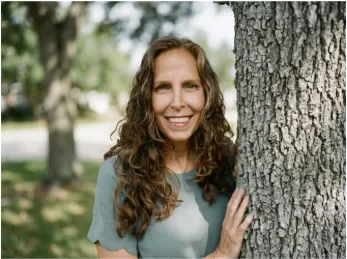
I'm far more interested in what's going on for you than I am in a label. We focus on what's showing up in your life and relationships, not a diagnosis.
My approach pulls from a few different places depending on what you need. Most women who find me have already tried: a few no's, the books, at least one podcast about boundaries listened to in the carpool line. It just doesn’t hold. Here’s how we work on why.
How the work Is Different Here
Brainspotting: For the Reactions You Can’t Talk Yourself Out of
Brainspotting was developed in 2003 by Dr. David Grand, and it rests on a simple idea: where you look affects how you feel. We bring up something that’s stuck, like the guilt after a boundary or the dread before a hard conversation. I slowly move a pointer across your field of vision and watch for where your body responds: a blink, a swallow, a shift in your breathing. You hold your gaze there while your brain does its own processing. Guilt and people-pleasing often started before you had words for them. Talk therapy can get you to “I know I shouldn’t feel this way.” Brainspotting works with the part that feels it anyway.
CBT: Catching the 2 a.m. Story
Cognitive behavioral therapy looks at how your thoughts, feelings, and actions feed each other. The thought “she’s quiet, I must have upset her” creates dread, and the dread sends you over-apologizing. We catch the thought and check it against what actually happened. Expect some cheeky mirror-back: I’ll read your harsh verdict back to you and ask if you’d say it to your best friend.
Somatic Work: Hearing Your Body Before Your Mouth Says Yes
Your body usually knows you don’t want to do something a few seconds before you agree to it. A tight throat. A drop in your stomach. We learn to notice those signals, so the gap between someone’s request and your answer gets wide enough for an actual choice.
Attachment-Based Work: Why Some Reactions Hit Harder
Your early relationships taught you whether it’s safe to need things, and what it costs to disappoint people. We look at how those lessons show up now, in your marriage, friendships, family, and work. Then we practice something different, starting in our own sessions.
You Already Know Something Needs to Change. You’ve Probably Known for a While.
If you’re ready to stop wondering whether you’re allowed to want more, and start learning how to ask for it, book a free 15-minute call.
You’ll know by the end of it whether this is the right fit.
Amy Ros, MS, LMHC-QS (FL MH15833), LPC (SC 9600)
Virtual sessions for clients located in Florida & South Carolina.
Questions About Individual Therapy
-
$150 for a 55-minute session. Many clients pay with HSA or FSA funds.
-
Yes, a limited number of plans. Use the insurance verification tool on this site to check your coverage and cost. If I’m out of network for you, I provide a superbill you can submit yourself; call your insurance and ask about out-of-network outpatient mental health benefits.
-
Yes. All sessions are virtual. You need to be physically located in Florida or South Carolina during each session.
Some plans are location-based and limit where sessions can be held
-
Because understanding a pattern and being free of it are two different things. If you can explain exactly why you people-please and still do it anyway, that gap lives in the nervous system. That’s what Brainspotting and somatic work are built for.
-
Both help the brain process experiences that talk alone doesn’t resolve. EMDR follows a structured protocol using back-and-forth eye movements, tapping, or tones. Brainspotting holds a single eye position linked to what you’re feeling, and follows your process more flexibly as it unfolds.
-
It depends on how long the pattern has been running and what’s feeding it. Many clients notice real shifts, like a shorter guilt spiral or an easier no, within the first couple of months. Deeper patterns take longer. We check in on progress together, reguarly.
-
No diagnosis is needed to start. If you pay out of pocket, we focus on what’s happening in your life with no label required. If you use insurance or submit a superbill, your plan will require a diagnosis code, and we’ll talk through that choice together.